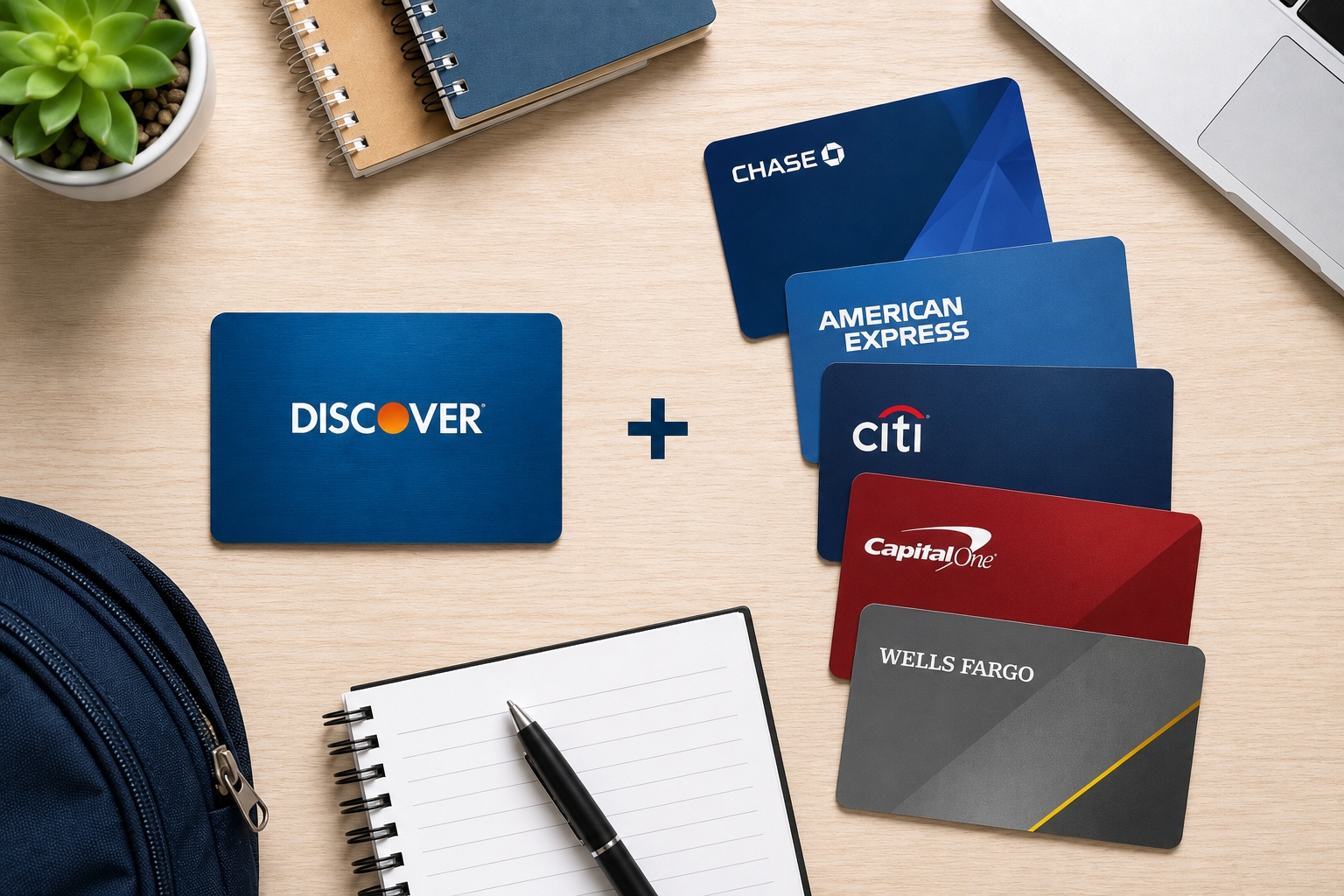
Choosing the Second Best Credit Card for portfolio is a very crucial step, for a Discover it holder it should be a flat rate catch-all that must eliminate the 1% baseline on purchases outside Discover’s rotating 5% categories.
For most beginners, a 2% flat-rate cashback card is the strongest choice. If a 2% card isn’t attainable due to limited credit history, then Capital One Savor Student is a good option, particularly for those who spend heavily on dining, groceries, entertainment and streaming. Also the Chase Freedom Unlimited is an excellent choice as well since it earns 1.5% on all purchases, 3% on dining and 3% at drugstores with a decent $200 SUB after $500 in spend over three months but Chase often denies applicants with less than 12 months of primary credit history, making it a less suitable immediate second card option for many students.
You may also read: Best Credit Card Setup for an 18 Years old. Choosing your First Card.
Reasons for choosing these cards are simple: Discover it already covers the rotating 5% categories. The remaining gap in the portfolio is the purchases that fall outside those categories, so the second card should maximize rewards on that spending.
Analyzing the Discover it First Year Cash Back Match vs Long Term Base Yields
The Discover it earns 5% cash back on rotating quarterly categories and 1% on all other purchases. However, during the first year, Discover’s Cashback Match doubles all the earned rewards. Effectively turning this card into a 10% earner in the rotating categories and a flat 2% cashback card on all other purchases. As a result, there’s actually no need for a dedicated catch all card during the first 12 months. After cashback match ends, when non bonus purchases start earning just 1%. That’s when adding a second card to the portfolio becomes the option.
For a typical college spender things like rideshare, groceries, restaurants — a large share of transactions fall outside any given quarter’s 5% bracket. Each of those dollars spent earns 1% reward on Discover it. So, our second card should raise that rewards floor by earning more than 1% rather than duplicating Discover’s rotating bonus categories.
This is what the widespread credit community fails to understand. New cardholders go for the highest single number they can find. While the correct framework is of coverage: what percentage of total spend earns above 1%.
Chase Freedom Unlimited vs a Flat 2% Cashback Card
Two paths dominate this decision. The first is a pure flat-rate card like Wells Fargo Active Cash or Citi Double Cash style product returning an unlimited 2% on everything, $0 annual fee plus a sign-up bonus. Its simple & predictable as well because of no category tracking.
The second is the Chase Freedom Unlimited: 1.5% base, 3% on dining and drugstores, 5% on Chase Travel, $0 annual fee, $200 bonus after $500 in spend.
The difference matters when dining volume takes charge. A 2% flat card beats the Freedom Unlimited’s 1.5% base by half a percentage point on general spend but dining is a dominant category for students. On restaurant transactions, the Freedom Unlimited returns 3% against a flat card’s 2%. However, our first card Discover it has historically included categories such as restaurants or digital wallets in some quarterly rotations, featuring dining or Apple Pay as a 5% rotating category, thus eliminating that 3% edge for major portions of the 1st year, marking it as a complete winner while leaving no room for a second card within that time frame. After the period ends a flat-rate 2% & Freedom Unlimited’s return narrow the gap and often exceeds it.
But there is a second variable to be considered as well. The Freedom Unlimited earns Chase Ultimate Rewards, which unlock transfer value if paired with a Chase Sapphire card later. A flat 2% card earns simple cash while restricts the usage to face value.
The choice is between optimization track (points, future travel leverage) and simplicity (guaranteed cash, no ecosystem lock-in).
Important Note: Other cards discussed operate on the Visa or Mastercard networks while the Discover it card operates exclusively on the Discover network. Depending on where you use the card, differences in merchant acceptance may influence your final decision, so keep this factor in mind as well.
Type of Cards to Avoid – A Perfect Tip For International Students
Cards like Chase Sapphire Preferred carries a $95 annual fee and a 100,000 point sign-up bonus after $5,000 in spend within three months. Offers are attractive no-doubt but for students the $5,000 minimum spend thing is the disqualifier. Most students cannot organically hit $5,000 in three months without manufacturing spend. Forcing your threshold anyway to capture such a bonus is transactional leakage disguised as reward.

Furthermore, cards with recurring Annual Fees should be your signs of avoidance: annual spend must generate enough incremental return to overcome the fee before the card breaks even. On a low income spend profile, that margin is thin to negative. Rules are clean, stay in $0 annual fee territory until spend volume and category value justify a fee. Premium card like Chase Sapphire, American Express etc are a later stage assets.
We cannot oversee the Foreign Fee Trap as well because international students or anyone planning to study abroad, this is a second major trap to avoid. Standard baseline cards including the Chase Freedom Unlimited and most flat 2% cashback cards charge a 3% foreign transaction fee. Swiping those cards outside the United States almost offset your rewards and actually costs you money on every transaction.
How Many Cards are Enough for a Student ?
A Discover it + one catch all card covers the full spend surface. Rotating 5% categories from the Discover it, plus a 1.5%–3% floor from the second card are enough. There is no need for a third card at this stage. So the goal is maintain 2 Cards.
Remember: a student should wait at least a full year before applying for a standard card like the Freedom Unlimited or anything similar/above to clear Chase’s 12 month credit history requirement. If applying at the six month mark, card options must be from the ones specifically designed for building credit, such as the Chase Freedom Rise or the Capital One Savor Student. This measures let the first account age, stabilizes the score and clears any card issuer velocity restrictions before the next application.
Important Things to Keep in Mind While Choosing The Correct Card
Optimizing rewards is the smaller lever. The larger one is knowing where the money goes. A cardholder who cannot itemize monthly spend by category cannot select the correct second card because the correct card is defined entirely by spend distribution. Money not spent is always a 100% return & no card can match that. Before the second application, track one to three months of spending and identify the true category weights. If dining and groceries dominate, the Freedom Unlimited’s 3% dining and the Capital One Savor’s 3% grocery/dining/entertainment become mathematically defensible. If our spend comes out flat and unpredictable, a 2% catch-all wins on simplicity.
Best Discover it Card Pairing Strategy and Our Final Verdict
Pair the Discover it with a dedicated student card like the Capital One Savor Student once your first year with Discover wraps up. This strategy successfully avoids Chase’s harsh underwriting rejections, bypasses the confusion over Capital One’s recent tier rebranding and leverages true $0 foreign transaction fees to give you a robust, zero-fee global wallet.
If you want a simple flat 2% cashback floor and have zero plans to travel internationally, card like Wells Fargo Active Cash is an excellent domestic alternative.
Same way, if you strongly prefer the Chase ecosystem due to its future travel transfer benefits, you must change your timeline: wait until you have a full 12 months of clean credit history to pair your Discover it with the Chase Freedom Unlimited. Doing so secures its 3% dining coverage and $200 signup bonus without triggering an automatic file rejection.
Either way, the portfolio rules remain clean: two cards, no annual fees and your applications spaced out properly— 6 months for Capital One or 12 months for Chase. Track your natural spendings first because card is the last decision, not the first.