

Approval while unemployed is possible but such decisions are driven far more by how income is reported than by how much money is in a savings account. A large cash balance may strengthen your overall financial position, yet it usually does not carry the same weight during underwriting unless it generates reportable income. That is why the practical focus shifts to reporting every income source the CARD Act allows, applying for cards with realistic approval standards and understanding that even a long relationship with a bank rarely overrides the issuer’s underwriting model. So, Savings still matter as part of someone’s financial profile but their actual value is limited to backstage instead of serving as the main reason an application is approved.
Savings & Payment History are not a Key to Approval
A very common assumption often gets naturally generated over time, like a 20 year old banking relationship and a spotless payment record can override an income gap. These factors doesn’t influence the Issuer as much a good credit profile and ability to pay can. Ability to pay is measured against reported incomes like salary, pension, rental income, investment income & Alimony or child support. The higher and more the stable income, approval odds automatically increase. Also, a rejection due to high outstanding credit cards balance does not always mean utilization was the only problem. Insufficient reported incomes can affect as well and large savings balances fails to cover such flaws, because of these things issuer evaluate deposits and underwriting separately.
An issuer does not review a savings account during a standard application. Even large CD holdings and their returns remain invisible unless the applicant enters them where the application allows. This has always been the core misalignment. Thats why a good long term relation, where your liquidity speaks will not do much against an underwriting model which doesn’t even have an income field to fill.
What counts as Income on Credit Card application when having No Job : CARD Act 2009 Explained
The CFPB’s rules under the CARD Act permit applicants aged 21 and older to report any income they have “a reasonable expectation of access to.” This is broader than employment wages. For someone living off assets, the followings are commonly reportable:-
- Investment and interest income, CD returns, dividends and interest count. If CDs generate $18,000 annually, that is reportable income.
- Retirement distributions – regular draws from retirement accounts.
- Trust or annuity distributions
- Household income — an applicant aged 21 or older may include income from a spouse or partner they can reasonably access.
The real problem is often under-reporting. An applicant who writes “$0” or leaves the income field blank simply because they are unemployed may significantly reduce their approval odds. Someone receiving $40,000 a year from CD interest, dividends or other investment income means he/she still has $40,000 in reportable income. If the application allows such income sources to be reported, then that amount belongs on the application.
Zero Dollar Credit Card Balance Hurts FICO Score
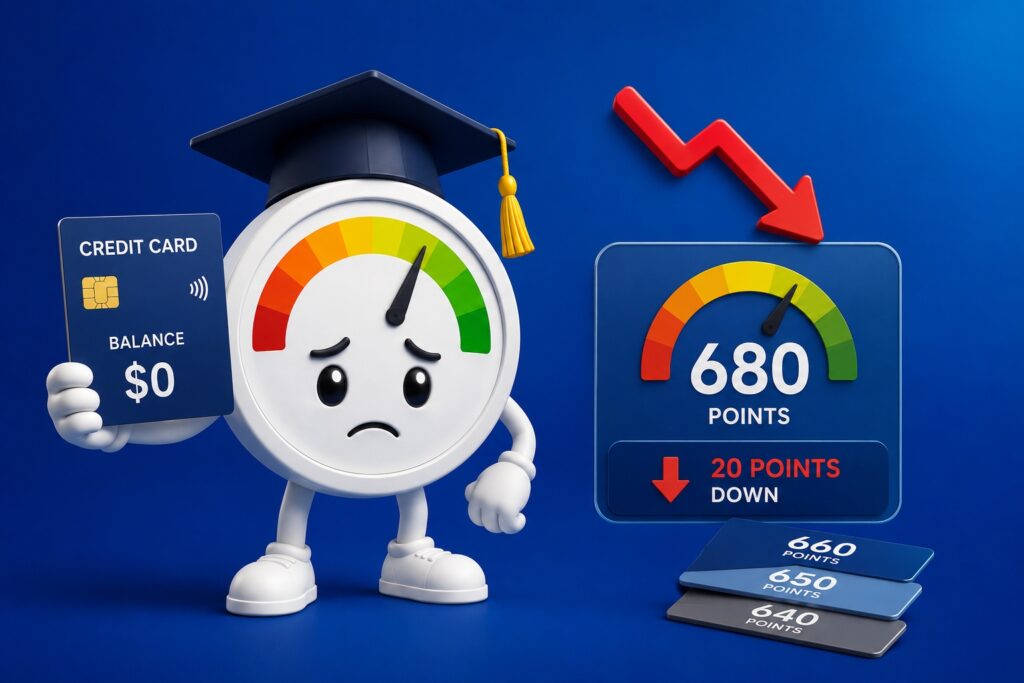
One of the biggest misconceptions in the credit community involves balance reporting. The tactic of paying a card to a “$0 reported balance” to appear low risk can sometimes backfire. All zero reporting across every revolving account can trigger a FICO penalty of up to roughly 20 points. The scoring model reads total dormancy as a lack of active credit management. Actual sweet spot is a low reported balance rather than a $0 balance, which is why we, like many other credit experts, recommend the AZEO Method for applicants who are optimizing their FICO score before applying for new credit. In many cases, keeping just one card reporting a balance below 10% of the credit limit while others at $0 produces better results.
On a $5,000 limit, that means letting roughly $50 to $400 report before payoff. Micromanaging a card to zero every other day is both excessive and counterproductive. It solves a problem the applicant does not have, while creating one they did not anticipate.
Another detail that often gets overlooked is when balances are reported. A statement balance and the balance reported to the credit bureaus are not always the same. Issuers send account data on their own reporting schedule, which may not match the statement closing date. For example, a large medical expense paid off a few days later may still be the balance reported to the bureaus, temporarily making utilization appear much higher than it usually is.
What happens if you apply for the same Credit Card right after a Rejection
It triggers a specific failure mode. If the second application falls within roughly 30 days of the first, the issuer may reuse the original hard inquiry and pull the same stale data. The applicant can end up with another denial before any meaningful changes have had time to influence the decision. Each additional application may also result in another hard inquiry, depending on the issuer’s policy.
Next corrective move in such cases is not to do repetition & make a good diagnosis of the outcome. Request the adverse action letter, identify the exact reason and address that specific issue before applying again. A denial based on high utilization requires a lower reported utilization. A denial driven by insufficient reported income requires higher reportable income. Guesswork due to personal ignorance leads to unnecessary hard inquiries only.
Skip Application & try a Product Conversion Process
Sometimes the best application is no application at all & such a process works in a specific way only. For an applicant whose only goal is a specific feature. Lets take for example ” a simple card with better everyday rewards or zero annual fees” then a new application may be unnecessary because many issuers permit a “product change” on an existing account. This converts a current card to a different product from the same issuer with no new hard inquiry and no fresh income underwriting.
Someone holding a 10 year old card with a $6,000 limit who needs ‘no FTF’ functionality can request conversion to a no foreign transaction fee product in the same family. This way the existing credit line and account age will also carry over. This sidesteps solves the entire income verification problem.
Another example with most demanding feature is no Annual Fee card with no Foreign transaction fees. Lets assume, a person holding any one card of Capital One from its large collection of 30 – 40 cards the company issued. Within Capital One ecosystem, if anyone’s still lacking this feature, then a product change to popular cards like Capital One Quicksilver OR Savor Cash Rewards Credit Card will easily solve a headache of getting a new card at no extra efforts. This is just one simple example of many possible scenarios. Choosing your optimal card, takes 20% of your efforts this way, to solve 80% of your problems.
Important: Product changes are not available for every card or every customer but when they are, they can solve the problem with a much lower friction than a new application will cause.
Type of Cards with Low Income Requirement for Easy Approval
If a new card is still the choice after the above points doesn’t suit your requirement, application strategy should favor products with lower income sensitivity and clear utility. No-annual-fee cards face lighter scrutiny than premium products.
A simple, straightforward, dependable everyday workhorse to choose is Capital One Quicksilver Cash Rewards comes with $0 annual fee, no foreign transaction fees, 1.5% flat cash back, $200 cash bonus after $500 in spend within three months.
Another card, Capital One Savor Cash Rewards with $0 annual fee, no foreign transaction fees, 3% back on dining, groceries, entertainment and streaming. Offers stronger category payout on routine monthly expenses with the same fee structure.
Premium travel products carry higher effective income expectations. Like Capital One Venture X ($395 annual fee) and Chase Sapphire Preferred ($95 annual fee) both waive foreign transaction fees but their approval bar and annual fee load makes them poor targets for someone living off savings.
Blueprint for getting a Credit Card without a Job
You will ease a process for yourself and credit card company and everyone inbetween, if the execution is planned, go like this –
- Check whether the existing card can be product changed to a required version — this will end the search with zero risk and zero new inquiries.
- Second, if a new card is needed, calculate total reportable income: CD returns, interest, dividends, retirement draws and accessible household income. Report the accurate figure, not “$0”
- Third, before applying, let a small balance under 10% of the limit get reported to the bureau rather than forcing a ‘$0’ that risks a scoring penalty.
- Fourth, apply to just one entry-level cashback card, such as the Quicksilver or Savor and stop. Dont stack applications. Each hard pull and each denial compounds the problem.
With the above mentioned steps done correctly, one can skip the avoided harassment and approval chances will gradually increase. Sometimes, the difference comes down to one overlooked distinction. Savings can finance your lifestyle for months or even years but an issuer’s underwriting model is not measuring how long your money will last. It is primarily evaluating the income that can be reported on the application. The two are not interchangeable and treating them as such is the single error that keeps qualified applicants in a denial loop.