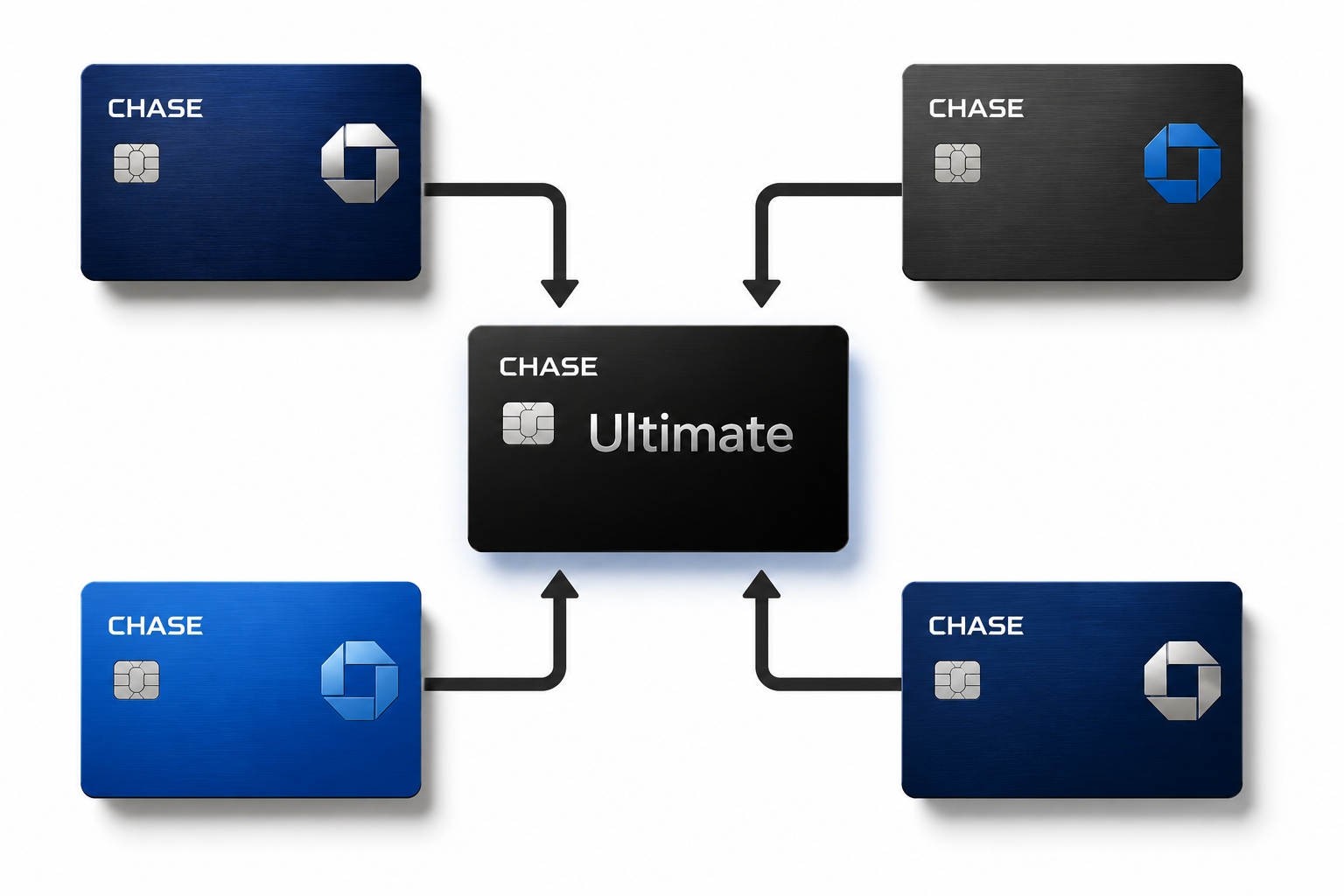
Complete the Chase Trifecta by adding two no annual fee cards to an existing Chase Sapphire Reserve, which are :-
- The Chase Freedom Flex
- The Chase Freedom Unlimited
This trio consolidates all spending into a single Ultimate Rewards (UR) pool.
Going one more level up adds the Quadfecta (a fourth Chase card), typically a business card for higher category coverage.
Prime Visa is another popular name which comes to mind when building this setup, the reason it doesn’t qualify despite being a 5% card is its cashback structure & this operates outside our today’s ecosystem, we covered this part as well for better understanding.
We have also build a tool to find out the maximum value you can attain from Trifecta & Quadfecta Setup plus some other best alternative cards you can use from your portfolio. We recommend reading the setup first before utilizing the tool available at the end.
Why Chase Sapphire Reserve is Must Have a Card
Main reason for holding Chase Sapphire Reserve is Redemption Hub not as an everyday earning card. The Sapphire Reserve carries a $795 annual fee and earns 1x on all non bonus purchases. This base rate is a surely less when compared to others for everyday spend. Then, why to choose it ? Because, its real value sits in its redemption style, not in earn rate: Points Boost delivers up to 2x value on top booked hotels and select flights through Chase Travel, plus transfers to travel partners.
The reason why Chase Trifecta fails for most people is they pair a premium redemption vehicle with a weak earning structure. Paying $795 to earn 1x on groceries and 1x at the gas pump is obvious loss. Thats why its best recommended to build a Trifecta like ours to overcome this drawback.
Making Reserve the redemption hub & Freedom cards as earning engines. All points pool together and inherit the Reserve’s maximum redemption value this way
Best Chase Trifecta Cards to Pair: Freedom Flex and Freedom Unlimited
Both companion cards carry a $0 annual fee. Both currently offer a $200 bonus after $500 in purchases within 3 months. Chase Freedom Flex earns 5% on rotating quarterly categories on up to $1,500 in combined purchases each quarter you activate. That $1,500 cap produces up to $75 back or 7,500 UR per quarter at the elevated rate. It also earns 3% on dining and 3% at drugstores. A notable addon is Cell Phone Protection up to $800 per claim when the phone bill is paid with the card. On the other hand Chase Freedom Unlimited earns a flat 1.5% (1.5x UR) on everything plus 3% on dining and 3% at drugstores. This card eliminates the Reserve’s 1x base rate drawback and this way every non bonus purchase moves from 1x to 1.5x then gets the Reserve’s premium redemption value.
These are the best places to spend-on to achive maximum value in this (Reserve,Flex,Freedom) Trifecta
- 1.5x flat catch-all
- 5x rotating categories
- 3x on dining and drugstores
- 4x on direct airline and hotel bookings
- 8x on flights, hotels and car rentals booked through Chase Travel via the Reserve.
| Category/Cards | Sapphire Reserve | Freedom Unlimited | Freedom Flex | Ink Business Cash |
| Dining | 4% | 3% | 3 | 2 |
| Tarvel | 4% | 1.5 | 1 | 1 |
| Grocery | 1 | 1.5 | 5 | 1 |
| Gas | 1 | 1.5 | 1 | 2 |
| Utilities/Telecom | 1 | 1.5 | 1 | 5 |
| Amazon | 1 | 1.5 | 1 | 1 |
| Everyday | 1 | 1.5 | 1 | 1 |
Reasons for skipping Prime Visa Despite 5 %
You might be wondering why your Prime Visa is not a part of our Ultimate Trifecta or Quadfecta. This confusion is of widespread credit community. The Prime Visa is issued by Chase and earns 5% at Amazon.com , Whole Foods and on Chase Travel with an eligible Prime membership. Well, it looks perfect for a natural fourth card but our reason for delisting is simple: it earns cash back not Ultimate Rewards points. Cash back cannot be pooled into the UR account. It cannot be routed through Points Boost or transferred to travel partners. Its 5% at Amazon is redeemed at a fixed $0.01 per point. So, it breaks the core redemption mechanism. Trifecta cards feed a single transferable currency. The Prime Visa produces a terminal, non transferable reward. High Amazon spend still justify its holding because 5% back is 5% back but it sits parallel to the Chase ecosystem, not inside it.
Card to Complete Chase Quadfecta
The Quadfecta requires a fourth UR earning card, so go with Ink Business Cash (requirement to obtain it is an eligible business or sole proprietor activity) upto first $25,000 spend at each anniversary year it earns 5% cashback at office supply stores and on internet, cable, phone services and 2% on the first $25,000 at gas stations and restaurants. Its rewards post as UR linked points and can be pooled with the Sapphire Reserve. The 5% on internet and phone bills is the standout feature of this card. That category up to $25,000 annually targets recurring fixed costs most cards relegate to the 1x base rate. Adding the Ink Business Cash to the portfolio converts those bills into premiun redemption points.
How to Combine and Pool Ultimate Rewards Points Across Chase Accounts
There is one mechanical requirement to complete our setup because personal and business cards utilize separate dashboards by default, you must combine your accounts under a unified Chase Business profile login (or call customer service to manually link them) so your points can be transferred into the Sapphire Reserve’s account. Freedom Flex and Freedom Unlimited technically earn “cash back” branded as points at 100 points per $1. When held alongside the Reserve, those points move into the UR ecosystem and gain Points Boost and transfer eligibility. This is the entire mechanism. A Freedom Unlimited earning 1.5x on a $10,000 annual catch-all spend generates 15,000 points. Redeemed as cash, that is $150. Routed through the Reserve’s premium redemption channels, the same points can be worth materially more. The idea behind whole setup is companion cards doing the earning & Reserve doing the redeeming.
Step by Step Setup To Complete The Chase Sapphire Reserve Trifecta Application Strategy
For any current Sapphire Reserve holder, the optimization must be a clear. Add the Freedom Unlimited first to eliminate the 1x base rate deficit as it will convert your every non bonus purchase to 1.5x. Then, add the Freedom Flex next to capture rotating 5% categories, up to $75 per quarter and pick up cell phone protection. Both are $0 annual fee, so there is no ongoing cost to holding them, only contributing upside in earn rate and pooled redemption value.
At last, only add the Ink Business Cash if a legitimate business use case exists and your recurring internet, cable or phone spend align the 5% category. Do not treat the Amazon Prime Visa as part of this structure. It earns fixed cash back and belongs in a separate asset allocation, useful for Amazon heavy spenders otherwise skip it, but still, it stays permanently outside our Ultimate Rewards pool.
Chase Ecosystem & Other Best Pairs
A data-driven breakdown of where to swipe based on real dollar valuations.
Note: Use the calculator above as a strategic reference to estimate the maximum rewards you can unlock from an optimal 3-4 card setup. This tool provides a highly accurate numerical estimate of your potential returns based on current valuations. Final benefits may vary depending on your location, specific spending patterns and individual redemption choices.
Chase Wallet FAQs & Pro Tips
Chase keeps personal and business accounts completely separate by default. To see all your cards in one place, you have to link them manually. You must merge your Personal profile into your Business profile, not the other way around. Do like this – Log into Chase Business account > Go to Profile & Settings > Account Settings > Manage Linked Accounts. From there, you can link your personal username. If the online tool glitches, simply call the customer service number on the back of your business card and ask the representative to “consolidate your personal and business profiles under your business username.”
No, you do not need a registered business, a corporate tax ID or an LLC. Millions of people apply as a Sole Proprietor. If you do any side hustle like selling items on eBay, freelancing, tutoring or managing a blog, you qualify as a sole business owner. When applying, you simply use your own legal name as the “Business Name” & your Social Security Number (SSN) as the “Tax ID.”
The 5/24 rule is Chase’s strict approval policy like if you have opened 5 or more personal credit cards (from any bank, not just Chase) in the last 24 months, Chase will automatically deny your application. Most Chase business cards (like the Ink Cash) require a person to be under 5/24 to get approved but once you get them, they do not report to your personal credit bureau. This means you are no longer bound to any 5/24 rule furthur, allowing you to build a massive card setup without locking yourself out of future approvals.
No, any card outside the Chase network operate on entirely separate reward platforms. You cannot pool their cash back into your Chase Ultimate Rewards portal. Our calculator accounts for this by converting all rewards into their raw annual cash value so you can see your true net profit, but you will redeem your Amex and Robinhood cash back separately through their respective apps.